<It's Everywhere> Kyuhwa Moon Solo show 문규화 개인전 6 March - 12 April, 2025

최종 수정일: 5월 7일


Neighboring Worlds, and Painting
For Kyuhwa Moon, the world emerges through the tangible entities encountered in everyday life. She perceives the passage of time through the shifting states of scallions growing in a neighbor’s garden, sculpts her body through kneading dough, and confronts winter in the severed trunk of a tree cut down in a chilly season. These are small, seemingly insignificant elements of the world, yet they function as conduits that connect the artist to her surroundings. At times, they transform into objects of contemplation, akin to reflections of the artist herself. Moon engages with these microcosmic presences—those that repeatedly appear, are observed, and are sensuously perceived within her daily environment—elevating them as subjects of her painting.
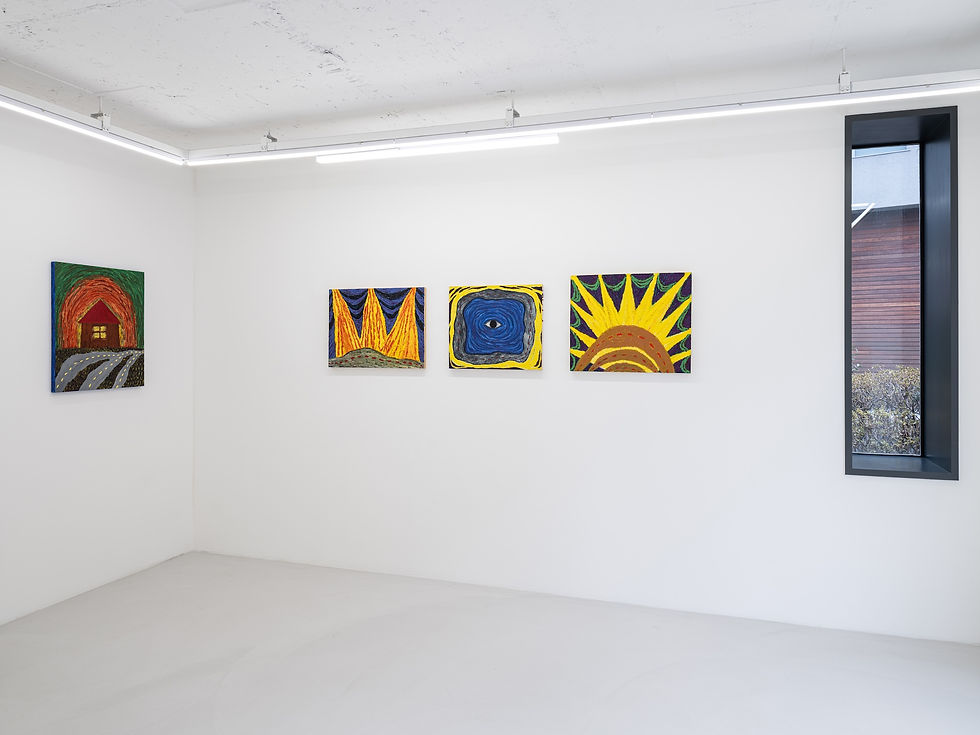
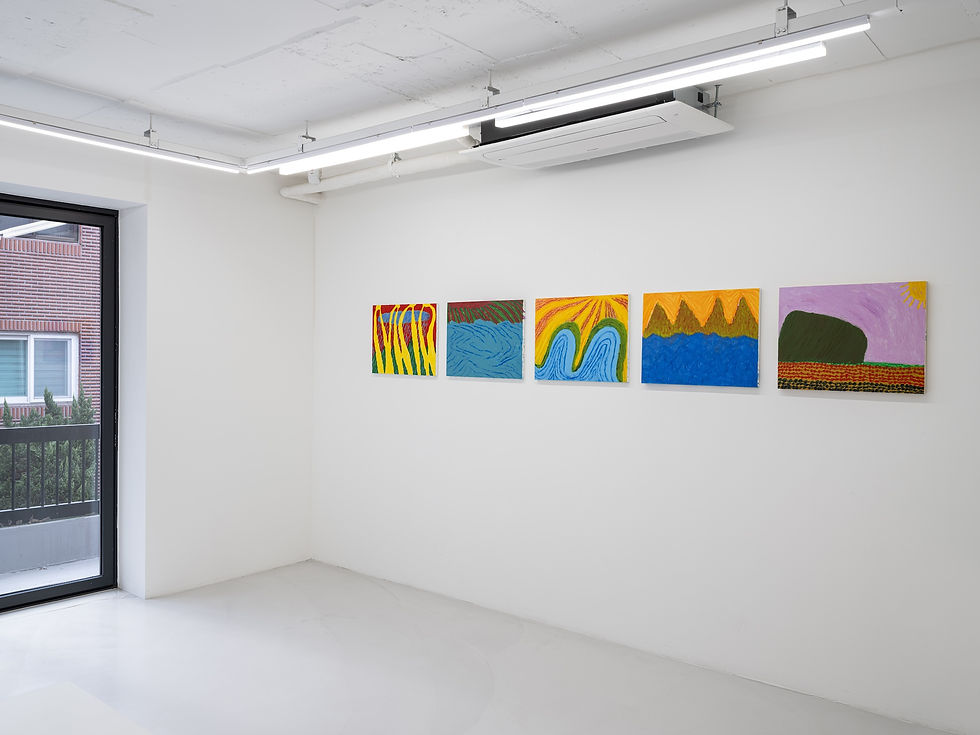
For the artist, painting becomes a temporal and spatial domain where communion with these everyday entities takes place. This interaction manifests not through objective depictions of their external forms but rather through compositional strategies that defy conventional perspective, simplified abstract shapes, and expressive brushstrokes. Objects, rendered in a close-up and immersive manner, emphasize their singular existence, while their unembellished outlines highlight the organic brushwork, chromatic depth, and textural richness of the pigments. The composition, reminiscent of Color Field painting, foregrounds individual forms in a way that reveals a painterly space animated by the artist’s gestures—a space that pulsates with the sensory engagement of the minute and the immediate.
An Indifferent Sky and the Unseen Heart
One day, an overwhelming surge of emotion swept over the artist. As she walked home, it felt as though the sun was trailing her every step. She longed for rain rather than sunlight, yet the sky remained resolutely bright, indifferent to her heavy heart. The temperature, humidity, and luminance—none of these external conditions mirrored her internal state. This dissonance between emotion and environment prompted a shift in her gaze from the ground to the sky. Recalling the alienation she felt from the unyielding sky, Moon sought to translate the fluidity of emotions into the shifting patterns of weather.
The sky, fickle and impervious to terrestrial affairs, resists clarity in the artist’s perception. Weather reveals itself through the subtle variations of brightness and saturation or the density and weight of the air rather than through distinct shapes or forms. The sky, unattainable and distant, appears to her like an inaccessible stage, yet its atmospheric shifts stir deep emotional responses in those bound to the earth. Inescapable beneath the heavens, weather becomes either an adversary to wrestle with or a companion to embrace—both physically and emotionally. With a complex mix of resistance, resignation, affinity, and acceptance, the artist lingers between sky and earth, between the internal and the external, capturing the signs of the atmosphere while seeking an inner equilibrium.
The Texture of Weather
For Moon, weather is not merely a visual phenomenon suspended above—it is something tangible, experienced through the body. It is revealed through the warmth that permeates the skin, the texture of the air brushing against it, and the weight of atmospheric pressure pressing down upon the body. To the artist, weather is both a physical and psychological response. To render visible the emotions and sensations of weather—imperceptible to others but vividly real to the individual experiencing them—Moon translates the intangible into material form, reinterpreting celestial events as terrestrial occurrences. To achieve this, she collects fabrics from street markets, selecting surfaces that could serve as a base to embody the tactile quality of weather. She discards traditional brushes that blend and soften boundaries, instead opting for oil sticks to directly imprint raw pigments onto the surface. The textures of the fabric, felt through her fingertips, evoke the physical sensation of weather, while her heavy, blunt strokes merge into forms suggestive of the sun, clouds, and waves—abstract yet expressive embodiments of emotional states. In this way, weather, once an ephemeral entity adrift in the sky, gains tangible boundaries and depth through the artist’s touch, taking on a wavering, pulsating form reminiscent of a trembling human body.
It's Everywhere
In Moon’s Weather series, the sun assumes an ambivalent nature. In Carried (2023), it descends to embrace the living beings standing upon the earth, while in Something Feels Slightly Off (2023), it looms as an authoritative presence surveying the land below. In Pressing Light (2023), it manifests as a contradictory force—both pressing down upon the earth and resisting the light of the sky. Similarly, other elements of weather—rain, clouds, heat—oscillate between melancholy and exuberance, embodying a multiplicity of emotional states. This theatrical rendering of weather arises from the artist’s sense of identification with it. In moments when weather ceases to be merely the backdrop of life and instead exerts a tangible force upon action, Moon finds herself unable to distinguish whether emotional turmoil originates from within or is imposed from without. When climate conditions become emotional triggers, weather exists as both an external world enveloping the artist and an internal subject residing within her. In Present Everywhere (2023), the sun is depicted with outstretched arms, as if reaching toward the earth—a sight impossible in reality but plausible as a metaphor for solar energy. Scientifically, the sun is approximately 150 million kilometers from Earth, making such an image an improbable literal depiction. Instead, it emerges as an emotional metaphor, symbolizing the psychological resonance of the celestial body. Thus, the sun in Moon’s paintings exists in a dual state—both omnipresent as an inescapable force from the sky and intimately internalized within the human psyche.
Kichan Yang, Curator of Gallery SP


이웃하는 세계, 그리고 회화
문규화에게 세계는 매일 당면하는 지상의 존재들을 통해 출현했다. 그는 이웃집 화단에서 자라는 대파의 변천으로부터 시간을 실감하였고, 빵 반죽을 통해 몸을 다듬을 수 있었으며, 어느 서늘한 계절에 절단된 나무로부터 겨울을 마주하였다. 이들은 세계의 일부를 이루는 작은 존재들이었으나 작가가 세계와 맞닿을 수 있도록 도운 매개물이자, 어느 순간 대상으로 둔갑한 세계처럼, 혹은 작가 자신의 반영처럼 다가왔다. 이처럼 문규화는 자신의 생활반경 속에서 반복적으로 접하고 관조하며 감각했던 미시 존재들을 회화의 소재이자 주제로 다루었다.
작가에게 회화는 일상의 존재들과 교감이 이루어지는 시공간이었다. 이런 흔적은 대상들의 외양을 객관적으로 묘사하는 방법이 아닌, 투시법에 반하는 전면적인 화면 구성과 추상적으로 단순화한 형태, 그리고 표현적인 획들로 드러났다. 가까이에서 긴밀히 들여다본 듯 화면상 가득하게 그려진 대상은 존재의 단일성을 조명하였고, 그것의 단조로운 외각은 형태 내부의 유기적인 붓질과 대상의 색감, 그리고 안료의 질감을 부각하였다. 흡사 색면추상처럼 형상을 정면으로 배치한 장면은 미시적인 것으로부터 감각할 수 있는 회화적 공간과 그 속에서 요동하는 작가의 몸짓을 순전히 드러내고 있었다.
무심한 하늘과 보이지 않는 마음
어느 날이었다. 커다란 울렁임이 밀려 들었고 귀가하는 동안 태양이 그의 걸음마다 쫓아오는 기분이었다. 해보다는 비가 필요했지만 무거운 마음과 반대로 하늘은 무심하도록 밝았다. 온도와 습도, 그리고 밝기 등 어느 무엇도 그의 심정에 부응해주지 않은 날이었다. 문규화의 시선이 땅으로부터 하늘로 옮겨진 계기였다. 작가는 심리적 요동과는 이질적이었던 하늘을 상기하며, 조금씩 움직이고 나아가는 감정을 날씨의 모습으로 담고자 했다.
지상에서 벌어지는 일들과 무관하게 변덕을 부리는 하늘은 작가에게 명징하지 않았다. 날씨는 밝기와 채도 등의 가벼운 인상으로, 때론 공기의 무게와 기온 등으로 짐작될 뿐, 선명한 형태와 덩어리는 없었으니 말이다. 극복할 수 없는 하늘과의 거리 속에서 관측된 날씨는 작가에겐 진입할 수 없는 무대 같았다. 반면에 사람의 손에 닿지 않는 천상은 땅의 존재들에게 정서적 요동을 일으키고 있었다. 하늘 아래에 거주하는 이상 숨거나 피할 수 없던 기후는 작가에게 씨름해야 할 상대이거나, 정서적으로나 육체적으로 동화할 동반자로 받아들여야만 했다. 그는 반감, 체념, 동질감, 포용, 그 외의 복잡한 심리적 동기들을 안고 하늘과 땅 사이, 사람의 바깥과 안에 서성이는 대기의 징후를 기록하며 내면의 안정을 살폈다.
날씨의 감촉
작가에게 날씨가 실재적일 수 있던 것은 그것이 하늘 위에만 머무는, 눈으로만 목격되는 자연 현상이 아니었기 때문이다. 피부 속으로 스며드는 기온, 살결을 감도는 공기의 질감, 그리고 온몸을 누르는 기압이 날씨를 알렸다. 그에게 날씨란 육체적이고 심리적인 반응이었던 것이다. 다른 이에겐 보이지 않았으나 당사자에겐 선명했던 날씨의 감정과 감각을 보증하기 위해 작가는 비물질의 산물을 물질로 전이하고, 하늘의 사건을 지상의 사건으로 번역하고자 했다. 이를 위해 문규화는 시장 거리를 나가 천을 수집하며 날씨의 촉감을 구현해 볼 바탕을 마련했다. 그리고 색의 경계를 버무리고 뭉개는 붓 대신 오일 스틱을 집어 들어 원색을 고스란히 표출하였다. 그는 손끝으로 감각한 천의 질감을 통해 날씨의 감촉을 상기할 수 있었고, 표면을 가로지르는 여러 갈래의 둔탁한 선들을 태양, 구름, 물결 등의 형태로 뭉쳐서 감정의 얼굴을 대변하였다. 그렇게 공중에 부유하던 날씨는 사람의 손길에 따라 경계와 두께를 갖출 수 있었고, 사람의 떨리는 몸처럼 일렁이는 형상을 얻었다.
어디에도 있어
작가의 날씨 연작에서 태양은 양가적인 성질을 내비친다. <업혀>(2023)에서 태양은 지상으로 내려와 땅을 딛고 서 있는 생명을 감싸는가 하면, <어딘가 조금씩 다 이상하다>(2023)에서는 땅을 내려다보는 위계적 존재로 표현된다. 때론 <누르는 빛>(2023)처럼 땅을 딛고 하늘의 빛에 저항하는 모순된 모습을 비추기도 한다. 마찬가지로 그림 속 비, 구름, 열기 등 날씨를 이루는 요소들은 우울하거나 유쾌한 분위기를 넘나드는 복합적인 성질을 보여준다. 이처럼 날씨들이 연극적으로 표현된 이유는 날씨와 작가가 서로 동화되어 출현하기 때문이다. 날씨가 삶의 배경이 아닌 행동을 간섭하는 힘으로 감각되던 순간, 작가는 마음의 동요가 안으로부터 오는지 밖으로 오는지 분별할 수 없었다. 기후의 상태가 정서적 요인으로 작동되었을 때, 날씨는 작가가 몸을 담고 있는 바깥 세계이자 동시에 내면에 자리하는 주체로 양립했다.
<어디에도 있어>(2023)에서 태양은 지상을 향해 팔을 뻗는 듯한 형상을 하고 있다. 현실에선 목격할 수 없는 모습이지만, 태양 에너지를 연상하였을 때 논리적으로 그럴듯한 의인화다. 반대로, 과학적으로 태양은 지구로부터 약 1억 5천만 km나 떨어져 있기에 회화 속 장면은 직서적 태양이 아닌 사람의 심정을 비유한 심상일 수 있다. 이로써 그림 속의 태양은 두 갈래의 존재로 잔존한다. 그것은 하늘로부터 도피할 수 없기에 어디에나 있으며, 내면에 간직되었기에 어디에도 있다.
글 양기찬 (갤러리에스피 큐레이터)


댓글